Frameless glass doors for an office at home: hinges, hardware and privacy
The screen is the easy part. The door is where the decisions are, because a frameless glass leaf has to hang off something, latch against something and close without waking the house.
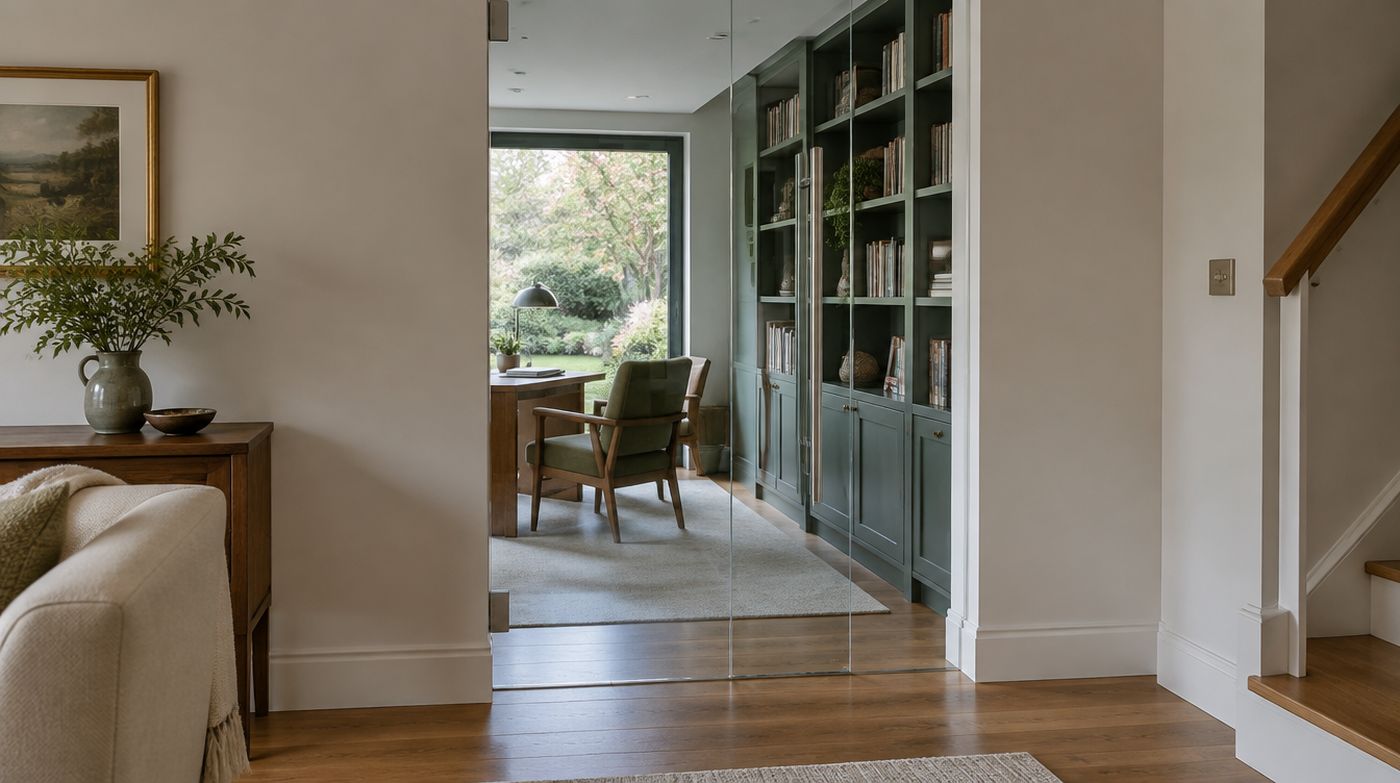
The frameless glass doors office fit-outs use are not house doors
Searches for frameless glass doors office tend to turn up commercial hardware: full height 12mm leaves on floor springs, patch fittings, overhead closers and electric locks, specified for an office entrance that sees two hundred people a day. In a house that is the wrong product. A door into a home study or a garden room gets opened perhaps twenty times a day by people who live there, and the specification should reflect that. Commercial fit-out is a separate trade and we leave it to the firms set up for it. What follows is about doors in houses.
The practical consequence is that you can use lighter, quieter and much cheaper hardware than a commercial schedule would give you, and you should. A 10mm toughened leaf on good concealed hinges will outlast the room it is in. Paying for a floor spring and a closer on an internal study door is money for a duty cycle you will never reach.
Hinge, pivot or slide, and how the floor decides
A hinged leaf is the default and usually the right answer. Two or three glass-to-wall or glass-to-glass hinges carry the leaf, there is nothing on the floor, nothing overhead, and the door behaves like a door. The hinges clamp through pre-drilled cut-outs in the glass, which is why the hinge choice has to be final before the panel is toughened. A hinged leaf wants a reasonably solid jamb: a glass-to-wall hinge fixing into a single sheet of plasterboard will work loose, so the stud or a packer behind it has to be there.
A pivot door turns on a point top and bottom rather than on a hinged edge, which lets the leaf be wider and heavier and lets it swing both ways. It looks superb on a wide aperture into a garden room. It needs a fixing point in the floor and in the head, and it leaves a gap down both sides of the leaf by design, so it is the worst of the three for noise. On a 700mm study door a pivot is showing off at your own expense.
A sliding leaf on a slim top-hung track keeps the swing out of a small room, and in a tight study where a hinged leaf would hit the desk it is the only sensible option. The trade-offs are that it needs a clear run of wall or glass for the leaf to park against, that it never seals well enough to be called acoustic, and that the track is visible. A good aluminium track with a soft stop at each end is quiet and reliable. A cheap one rattles, and you will hear it every day.
The floor usually settles the argument. On a level timber floor all three work. On a floor that falls across the opening, a hinged leaf can be hung to follow the gap and still look right, whereas a sliding leaf runs on a level track and the gap under it visibly tapers. On underfloor heating, anything needing a floor fixing gets difficult, which rules out most pivots and floor springs and pushes you to hinges or a top-hung slider.
Hardware: handles, latches, and what does not work on glass
On a frameless leaf, everything fixes through a hole in the glass or clamps over its edge, and both of those have to be set out before toughening. There is no adjusting afterwards and no drilling on site, so the handle position, the latch position and the hinge centres are all decided at survey. Get the handle height right for the people using it, not for the drawing.
A back-to-back pull handle through a single pair of holes is the simplest and the most robust fitting you can put on a glass door. Nothing to go wrong, nothing to wear out. If you want the leaf to stay shut, a magnetic catch into a small striker on the frame or on the fixed panel does the job silently and with no moving parts. A sprung latch with a lever gives you a positive click and a proper handle action but needs a patch fitting on the leaf edge, which is more hardware, more cost and more to look at.
Some things genuinely do not work. Mortice locks, rim locks, letterbox plates, door closers screwed to the face of the leaf, and anything that wants a screw into the material rather than through it are all out. A keyed lock on a glass leaf is possible with the right patch, and on an internal study door it is almost always a waste. If the household needs to be kept out, a magnetic catch and a conversation will do it. Spend the money on the hinges instead, because the hinges are what you touch every time and the hinges are what fail if they are cheap.
Closing a glass door quietly, and the gaps round the edge
A 10mm toughened leaf weighs roughly 25kg per square metre, so a 2.1m by 0.8m door is close to 42kg of glass swinging on two hinges. Closed carelessly it makes a noise. There are three things that fix it: hinges with a decent amount of friction so the leaf does not fly, a soft buffer where the leaf lands, and a magnetic catch that holds it rather than a latch that has to be slammed into engagement.
The gaps are the other half of the story. A frameless leaf needs clearance at the hinge edge to swing, a few millimetres at the latch edge, and a gap at the bottom to clear the floor. Add those up and you have an open slot round the perimeter of your door. If the door exists to reduce noise from the rest of the house, that slot has to be dealt with: a brush or wiper seal at the bottom is the single most effective thing you can add, and a soft seal down the latch edge helps. If the door exists purely to look like a door, leave the gaps alone and save the money.
Privacy on the door leaf itself
A clear leaf is a window into your study. Most people are happy with that and some are not. The options, in order of how much light they keep, are clear, low iron clear, reeded or fluted, satin etched, and then applied film.
Reeded and fluted glass is the one we fit most on study doors. The vertical ribs break the image up completely at a metre away while passing nearly all the light, and because the pattern is directional it reads as a deliberate piece of design rather than as a concession to privacy. Worth knowing: the ribs are on one face, so they want to face into the room you are happy to clean, and a heavily reeded leaf is slightly harder to wipe than a flat one.
Satin etched glass, often sold as frosted, gives even obscuration and a softer look. It passes a bit less light than reeded. The one caution is fingerprints: a satin surface shows hand marks around a handle more than clear glass does, which on a door that gets pushed open twenty times a day is a real consideration. There are easy-clean etched products that help. Applied film we would generally steer you away from on a door, because the edges lift on a surface that is handled constantly.
On a fully clear leaf in a frameless screen, there is also a safety point rather than a privacy one. A large clear glass door with no frame and no hardware in the middle of the view can genuinely be walked into. Approved Document K expects glazing in critical locations to be apparent, which in practice means the handle, a manifestation band or an obscured pattern gives the eye something to register. A pull handle at a sensible height usually satisfies it on its own.
Do you need a door, or just an aperture?
It is worth asking properly, because a door is often a third of the cost of the whole screen and frequently is not used. If the screen is there to zone a space, give a desk a boundary and keep daylight moving through the room, an open aperture is cheaper, looks cleaner, needs no hardware and gives you back the wall the leaf would have swung across. Plenty of home office screens work better without a leaf.
The test is whether you will actually close it. If the honest answer is that it will sit open permanently because the room is too small to lose the swing, or because you like being able to hear the kitchen, do not buy it. If the answer is that you need to shut the door at the start of a call, buy a door with a bottom seal and get the benefit. A door fitted and never closed is the most common piece of wasted money on this kind of job.
The middle option people forget is an aperture now and a leaf later. If the fixed panels are set out with a hinged leaf in mind, with the jamb detail and the structural fixing points already in place, a door can be added in a year without touching the glass that is already in. That costs very little to allow for at the survey and nothing at all to decline.
Safety glass, standards and the paperwork
Any glass door is a critical location in the sense of Approved Document K, and so is the glazing immediately beside it. That means toughened or laminated safety glass, nothing else. Toughened glass is made to BS EN 12150 and marked to confirm it meets BS 6206 Class A, and the mark is usually sandblasted into a bottom corner where you will see it if you look. Laminated glass is made to BS EN 14449 and holds together on breakage, which matters overhead or where a fall is possible but is rarely needed on an internal study door at ground level.
We cut, edge, polish and toughen the glass for these doors in our own workshop at 6 Atlas Road in Wembley, which means the hinge cut-outs and handle holes are drilled by the same people who took the survey dimensions. That is the main reason frameless glass doors fail to fit: a set of dimensions passed between three companies. One last piece of advice. If you have been quoted for the frameless glass doors office suppliers fit as standard, ask what the hardware duty rating is for and whether your household will ever reach it, because that is the easiest few hundred pounds to take off a domestic quotation. Survey across London is free, the quote is fixed and written, and the number on it covers the hardware as well as the glass. Call 020 4634 6045, Monday to Friday, 8am to 5pm.
FAQ
Questions about frameless glass doors office
Can a frameless glass door be hung off a glass partition instead of a wall?
Yes. Glass-to-glass hinges clamp through pre-drilled holes in both the fixed panel and the leaf, and this is a standard arrangement in a frameless screen. Two conditions matter. The fixed panel has to be stiff enough and well enough restrained at floor and head to carry the swinging load without flexing, which usually means 10mm or 12mm toughened and a decent panel width rather than a narrow strip. And the hinge positions must be set out before either panel is toughened, because neither can be drilled afterwards. If the fixed panel is narrow, hanging off the wall at that end is the sounder option.
Do frameless glass doors lock?
They can. A patch fitting on the leaf edge will take a sprung latch with a thumbturn or a key, engaging a striker in the frame or in an adjacent glass panel. On an internal door into a home office we rarely recommend it. The hardware is bulkier, it costs more, it adds a point of wear, and the security value is close to nil because the panel beside it is glass. If the aim is simply that the door stays shut rather than drifting open, a magnetic catch does that silently for a fraction of the cost. Locks make sense on a garden room door, where they are part of the external security.
Is a sliding or a hinged glass door better for a home office?
Hinged is better unless the room cannot spare the swing. A hinged leaf seals more closely on all four edges, so it does more for noise, it has no visible track, and the hardware is simpler and quieter over years of use. Sliding wins when the study is small enough that a swinging leaf would foul a desk or a chair, or when the aperture is wider than a single hinged leaf can comfortably cover. If you go sliding, budget for a good quality track: the difference between a quiet slider and an irritating one is almost entirely in the track and rollers, not the glass.
Get a price for your glass screen
Tell us the opening and what you are trying to separate. We survey across London and quote in writing with the glass and hardware stated.